

How To Draw A Circle In Pixels

Rasterizing a circle of radius 23 with the Bresenham midpoint circle algorithm. Only the green octant is actually calculated, it's simply mirrored eight times to form the other seven octants.
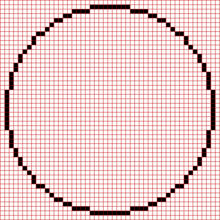
A circle of radius 23 drawn by the Bresenham algorithm
In calculator graphics, the midpoint circle algorithm is an algorithm used to determine the points needed for rasterizing a circle. Bresenham'south circle algorithm is derived from the midpoint circumvolve algorithm.[ citation needed ] The algorithm can be generalized to conic sections.[1]
The algorithm is related to work past Pitteway[2] and Van Aken.[3]
Summary [edit]
This algorithm draws all 8 octants simultaneously, starting from each cardinal direction (0°, 90°, 180°, 270°) and extends both ways to accomplish the nearest multiple of 45° (45°, 135°, 225°, 315°). It can determine where to terminate because when y = x, information technology has reached 45°. The reason for using these angles is shown in the above picture: As x increases, it does non skip nor repeat any x value until reaching 45°. So during the while loop, x increments past ane each iteration, and y decrements by i on occasion, never exceeding 1 in one iteration. This changes at 45° because that is the point where the tangent is ascension=run. Whereas rise>run before and ascent<run after.
The 2d role of the problem, the determinant, is far trickier. This determines when to decrement y. Information technology usually comes after cartoon the pixels in each iteration, considering information technology never goes below the radius on the first pixel. Because in a continuous function, the function for a sphere is the function for a circle with the radius dependent on z (or whatever the tertiary variable is), it stands to reason that the algorithm for a detached(voxel) sphere would also rely on this Midpoint circle algorithm. But when looking at a sphere, the integer radius of some adjacent circles is the same, but information technology is not expected to accept the aforementioned exact circle side by side to itself in the same hemisphere. Instead, a circle of the same radius needs a different determinant, to allow the curve to come in slightly closer to the centre or extend out farther.
- One hundred fifty concentric circles drawn with the midpoint circle algorithm.
-

On left, all circles are drawn black.
-
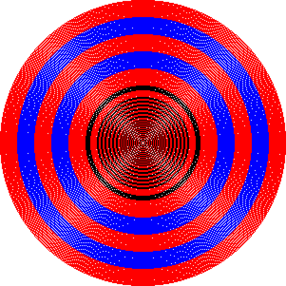
On correct, ruby-red, black and blue are used together to demonstrate the concentricity of the circles.
Algorithm [edit]
The objective of the algorithm is to approximate the curve using pixels; in layman'due south terms every pixel should be approximately the same distance from the middle. At each footstep, the path is extended by choosing the adjacent pixel which satisfies only maximizes . Since the candidate pixels are adjacent, the arithmetics to calculate the latter expression is simplified, requiring only bit shifts and additions. But a simplification tin be done in order to understand the bitshift. Keep in heed that a left bitshift of a binary number is the same equally multiplying with ii. Ergo, a left bitshift of the radius but produces the diameter which is defined every bit radius times two.
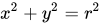
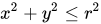

This algorithm starts with the circle equation. For simplicity, assume the heart of the circle is at . Consider starting time the first octant only, and draw a bend which starts at point and gain counterclockwise, reaching the angle of 45.


The fast direction hither (the basis vector with the greater increase in value) is the management. The algorithm e'er takes a step in the positive direction (upward), and occasionally takes a stride in the ho-hum direction (the negative direction).


From the circle equation is obtained the transformed equation , where is computed but once during initialization.


Let the points on the circle be a sequence of coordinates of the vector to the point (in the usual basis). Points are numbered according to the society in which drawn, with assigned to the beginning point .

For each point, the following holds:
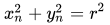
This tin can be rearranged thus:
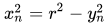
And also for the side by side point:

Since for the first octant the next bespeak will always be at to the lowest degree 1 pixel higher than the last (only too at most 1 pixel higher to maintain continuity), it is true that:
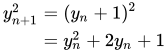

And so, rework the next-point-equation into a recursive one by substituting :


Because of the continuity of a circle and because the maxima forth both axes is the same, clearly it will not exist skipping x points every bit it advances in the sequence. Usually it stays on the same x coordinate, and sometimes advances by 1.
The resulting coordinate is then translated past adding midpoint coordinates. These frequent integer additions do non limit the performance much, as those square (root) computations can be spared in the inner loop in turn. Again, the zero in the transformed circumvolve equation is replaced by the error term.
The initialization of the error term is derived from an offset of ½ pixel at the first. Until the intersection with the perpendicular line, this leads to an accumulated value of in the fault term, then that this value is used for initialization.

The frequent computations of squares in the circumvolve equation, trigonometric expressions and square roots tin can again be avoided by dissolving everything into single steps and using recursive computation of the quadratic terms from the preceding iterations.
Variant with integer-based arithmetic [edit]
But every bit with Bresenham's line algorithm, this algorithm can be optimized for integer-based math. Because of symmetry, if an algorithm can exist found that merely computes the pixels for i octant, the pixels tin can be reflected to become the whole circle.
Nosotros start by defining the radius error as the difference betwixt the exact representation of the circle and the center indicate of each pixel (or any other arbitrary mathematical betoken on the pixel, so long every bit information technology's consistent across all pixels). For any pixel with a heart at , the radius error is defined equally:


For clarity, this formula for a circumvolve is derived at the origin, only the algorithm can exist modified for any location. It is useful to kickoff with the indicate on the positive X-axis. Because the radius will be a whole number of pixels, clearly the radius error will exist zero:

Considering it starts in the showtime counter-clockwise positive octant, information technology will step in the management with the greatest travel, the Y direction, then it is clear that . As well, because it concerns this octant only, the X values have only ii options: to stay the same equally the prior iteration, or decrease by 1. A conclusion variable can exist created that determines if the post-obit is true:


If this inequality holds, then plot ; if not, then plot . So, how to decide if this inequality holds? Start with a definition of radius mistake:



The absolute value office does not aid, so square both sides, since a square is e'er positive:
![{\displaystyle {\begin{aligned}\left[(x_{i}^{2}-2x_{i}+one)+(y_{i}^{2}+2y_{i}+1)-r^{two}\correct]^{ii}&<\left[x_{i}^{two}+(y_{i}^{2}+2y_{i}+1)-r^{2}\right]^{2}\\\left[(x_{i}^{2}+y_{i}^{2}-r^{2}+2y_{i}+1)+(i-2x_{i})\right]^{ii}&<\left[x_{i}^{2}+y_{i}^{2}-r^{2}+2y_{i}+i\right]^{ii}\\\left(x_{i}^{2}+y_{i}^{two}-r^{ii}+2y_{i}+1\right)^{two}+2(1-2x_{i})(x_{i}^{two}+y_{i}^{ii}-r^{2}+2y_{i}+one)+(one-2x_{i})^{2}&<\left[x_{i}^{2}+y_{i}^{two}-r^{ii}+2y_{i}+i\right]^{2}\\2(one-2x_{i})(x_{i}^{two}+y_{i}^{two}-r^{2}+2y_{i}+1)+(ane-2x_{i})^{ii}&<0\\\end{aligned}}}](https://wikimedia.org/api/rest_v1/media/math/render/svg/0818c8732e78a64182d8229371aa2f8c59d5e158)
Since x > 0, the term , so dividing gets:
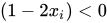
![{\displaystyle {\begin{aligned}2\left[(x_{i}^{2}+y_{i}^{2}-r^{2})+(2y_{i}+1)\right]+(1-2x_{i})&>0\\2\left[RE(x_{i},y_{i})+Y_{\text{Change}}\right]+X_{\text{Change}}&>0\\\end{aligned}}}](https://wikimedia.org/api/rest_v1/media/math/render/svg/b4edd2f984e728a380b43a4f3be840ac30b2e07e)
Thus, the conclusion criterion changes from using floating-point operations to uncomplicated integer addition, subtraction, and bit shifting (for the multiply by 2 operations). If , and so decrement the 10 value. If , and then keep the aforementioned X value. Again, by reflecting these points in all the octants, a total circumvolve results.


Drawing incomplete octants [edit]
The implementations above always draw simply consummate octants or circles. To draw only a certain arc from an bending to an angle , the algorithm needs first to calculate the and coordinates of these end points, where it is necessary to resort to trigonometric or foursquare root computations (encounter Methods of computing foursquare roots). Then the Bresenham algorithm is run over the complete octant or circle and sets the pixels only if they fall into the wanted interval. Subsequently finishing this arc, the algorithm can be ended prematurely.


If the angles are given equally slopes, and so no trigonometry or foursquare roots are necessary: merely check that is between the desired slopes.

Generalizations [edit]
Information technology is too possible to use the same concept to rasterize a parabola, ellipse, or any other two-dimensional curve.[4]
References [edit]
- ^ Donald Hearn; K. Pauline Bakery (1994). Figurer graphics . Prentice-Hall. ISBN978-0-13-161530-4.
- ^ Pitteway, M.L.V., "Algorithm for Drawing Ellipses or Hyperbolae with a Digital Plotter", Reckoner J., 10(3) Nov 1967, pp 282-289
- ^ Van Aken, J.R., "An Efficient Ellipse Drawing Algorithm", CG&A, 4(ix), September 1984, pp 24-35
- ^ Zingl, Alois (December 2022). "The Beauty of Bresenham'due south Algorithm: A simple implementation to plot lines, circles, ellipses and Bézier curves". like shooting fish in a barrel.Filter. Alois Zingl. Retrieved xvi Feb 2022.
External links [edit]
- Cartoon circles - An article on cartoon circles, that derives from a unproblematic scheme to an efficient one
- Midpoint Circle Algorithm in several programming languages

Source: https://en.wikipedia.org/wiki/Midpoint_circle_algorithm
Posted by: mullengazincomed79.blogspot.com
0 Response to "How To Draw A Circle In Pixels"
Post a Comment